

Expat in France?
Moving to France isn’t just about changing your location… It’s about changing your entire operating system.
The language changes, the rules flip, and honestly? Sometimes your confidence takes a bit of a hit, too.
When I first landed in France, everything looked beautiful. But the real challenge started when I had to figure out the French Health System. It wasn’t just paperwork; it was a maze.
This blog isn’t just information—it’s my personal experience. I’m writing this so you don’t have to struggle through the same confusion I did.
Table of Contents
1. Before You Fly: The Documents You Cannot Forget
Trust me, get these sorted while you are still in your home country.
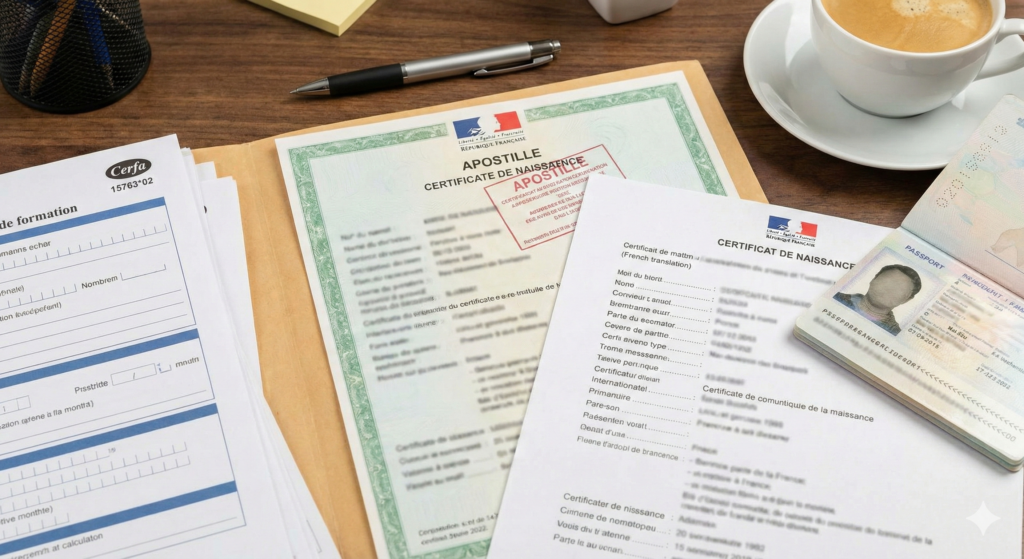
✔ The Birth Certificate (With Apostille)
Your birth certificate must usually have an Apostille. This is non-negotiable for getting your Social Security number later.
✔ French Translation
English won’t work here. You need a mandatory French translation of your birth certificate. You can often get this done via an Alliance Française or authorized translator in your home country.
⚠️ Crucial Tip – Translation Validity: While translations done abroad are often accepted, some CPAM offices are extremely strict. They might reject the foreign translation and demand one from a ‘Traducteur Assermenté’ (Sworn Translator) physically located in France.
👉 My Advice: Check your region’s rules, or to be 100% safe, just get it translated by a Sworn Translator once you land in France.
2. Landing in France: The CPAM Registration Maze
Here is where the big confusion happens—not everyone gets a card immediately. It depends on your visa:
- 👔 If you are working (Salarié / Passeport Talent): You are lucky. You can apply as soon as you start your job.
- 🏠 If you are a Dependent (Visitor/General Dependent): If you aren’t working, you apply under PUMA (Protection Universelle Maladie). However, there is a catch: You must reside in France for 3 months before you are eligible to apply.
3. How to Apply? (Paper vs Online)
This is where most people get stuck. If you are a dependent or visitor, you likely cannot apply online initially.
Method 1: By Post (The Standard Way for Dependents)
This is the most reliable method for paperwork in France.
- Download and fill Form Cerfa 15763*02 (S1106).
- Attach photocopies of all documents (Passport, Visa, Birth Certificate + Translation, RIB).
- Send it via La Poste using ” Lettre Recommandée avec Avis de Réception ” (Registered Post).
👉 Why this is better: You get a legal receipt proving CPAM received your file.
Method 2: The Drop-off
If you don’t want to post it, go to your local CPAM office (like in Toulouse) and look for the Urne (Drop Box) outside. Just drop the envelope there.
Method 3: Online (Restricted)
There is a portal called etudiant-etranger.ameli.fr , but this is specifically for Students . Most dependents will need to use Method 1 (Paper) to open their rights first.
📂 Document Checklist
- Application Form (Cerfa 15763*02)
- Passport + Visa copy
- Proof of Residence (3 months old bill if dependent)
- Birth Certificate (With Apostille & French Translation)
- Bank RIB ( Tip: Use a French Bank RIB. Foreign IBANs often get rejected).
4. The Timeline & Compte Ameli
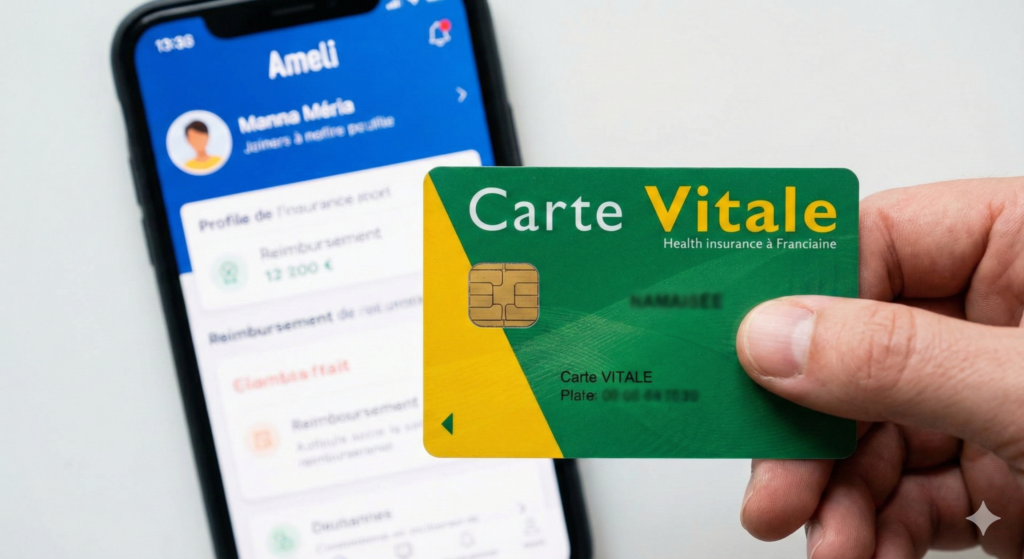
- First, you might get a Temporary Social Security Number.
- The Permanent Number takes 3–6 months (sometimes more).
- Finally, you receive the Carte Vitale (Green Card).
What if you get sick while waiting?
If you visit a doctor, ask for a Feuille de soins (a brown reimbursement form). You have to fill this out and post it to CPAM. It’s manual, but you will get your money back.
📱 Compte Ameli – Your Digital Control
As soon as you get your Permanent Social Security Number, do this immediately:
- Create an account on Ameli.fr.
- Download the Ameli App.
This is where you track your reimbursements, download coverage certificates, and order your card.
5. What is “Mutuelle” and why do you need it?
In France, Social Security usually covers only about 70% of your medical costs. The remaining 30%? That comes out of your pocket unless you have a Mutuelle (Complementary Insurance).
You can either get on your husband/partner’s company insurance (the easiest option) or buy a private policy.
⚠️ Check with HR: Some companies make it mandatory to cover the family, while for others it’s optional and deducted from the salary. Always check if Dental and Optical are covered!
🔗 The Critical Step: Linking Mutuelle to Carte Vitale
Just buying Mutuelle isn’t enough. It needs to “talk” to your Social Security card. This is called Télétransmission.
When this is active, the doctor swipes your card, Social Security pays its part, and the Mutuelle automatically pays the rest. No paperwork. If they aren’t linked? You are stuck filling out forms manually. Always check your app to see if “Télétransmission” is activated!
6. Sector 1 vs Sector 2 Doctors (The Big Difference)
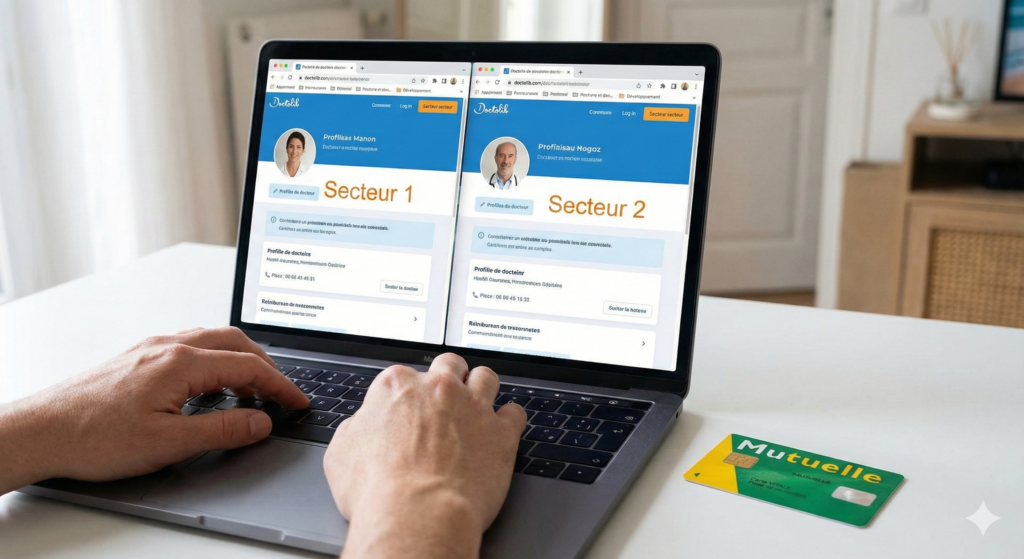
In France, doctors fall into two sectors. Knowing this saves you money:
- Government fixed fees.
- Social Security + Mutuelle usually cover 100%.
- Result: Zero out-of-pocket cost for you.
- Charge extra fees ( Dépassements d’honoraires ).
- Not fully reimbursed by Social Security.
- Result: You pay the extra cost yourself (unless you have a premium Mutuelle).
👉 Tip: When booking on Doctolib, always check the sector so you aren’t shocked by the bill.
7. GP (Médecin Traitant) & Financial Impact
In France, a GP is the foundation of the system. They hold your medical history and give specialist referrals. The Financial Impact of Declaring a GP:
- GP Declared: You get ~70% reimbursement.
- GP NOT Declared: You get only ~30% reimbursement.
Basically, not declaring a GP directly hurts your wallet.
Finding a Doctor: My Struggle in Toulouse
This was the hardest part of my journey. I was new in Toulouse, my French was weak, and I needed an English-speaking doctor.
I called clinic after clinic, but everyone said the same thing:
“Sorry, no new patients.”
Doctolib (the booking app) was fully booked.
Finally, a friend recommended her GP. This doctor wasn’t even on Doctolib! I had to physically go to the clinic to get an appointment.
But I finally found an English-speaking GP who could treat the kid and me. That was the day I truly felt settled in France.
8. Emergency Numbers
Save these. In an emergency, you will be treated even if you don’t have a Social Security number yet.
- 📞 15 – Medical Emergency (SAMU)
- 📞 18 – Fire Brigade (Pompiers)
- 📞 112 – European Emergency
9. Frequently Asked Questions
Can I apply for Carte Vitale online?
Usually, no. If you are a dependent or first-time applicant (non-student), you must send the paper form (Cerfa 15763*02) by post. Online accounts (Ameli) can only be created after you receive your permanent Social Security number.
Do I really need an Apostille on my Birth Certificate?
Yes. For many non-EU citizens (depending on your country’s agreement with France), an Apostille issued by your home country’s government is mandatory for long-stay visa holders registering for Social Security.
Final Thoughts
The French health system is robust, but the entry barrier is high. The language, paperwork, and waiting periods can be mentally exhausting. But once your Social Security, Mutuelle, and GP are set up? The system is secure and trustworthy.
Coming up next: All about CAF and coverage for kids!




[…] ✔ Must have applied for Social Security (temporary number also works)(If you haven’t applied for CPAM yet or want to understand the process, you can read my detailed guide here: The Complete Guide to CPAM & Carte Vitale) […]
[…] Before reading this, definitely read my ‘France Health System Guide‘ and ‘CAF & Family Benefits‘ […]