

🇫🇷 Pregnancy in France: From Pregnancy Test to Birth Certificate (Complete Guide)
(My experience, the right process, hospital reality, and things nobody tells you)
When I first found out about my pregnancy in France, I was a little nervous initially—new country, new language, and a totally different medical system. But today, after this whole journey, I can say with full confidence that the French healthcare system is one of the safest and most structured in the world.
If you just understand the process, this journey can be super smooth. I have prepared this guide based on my own experience and research. 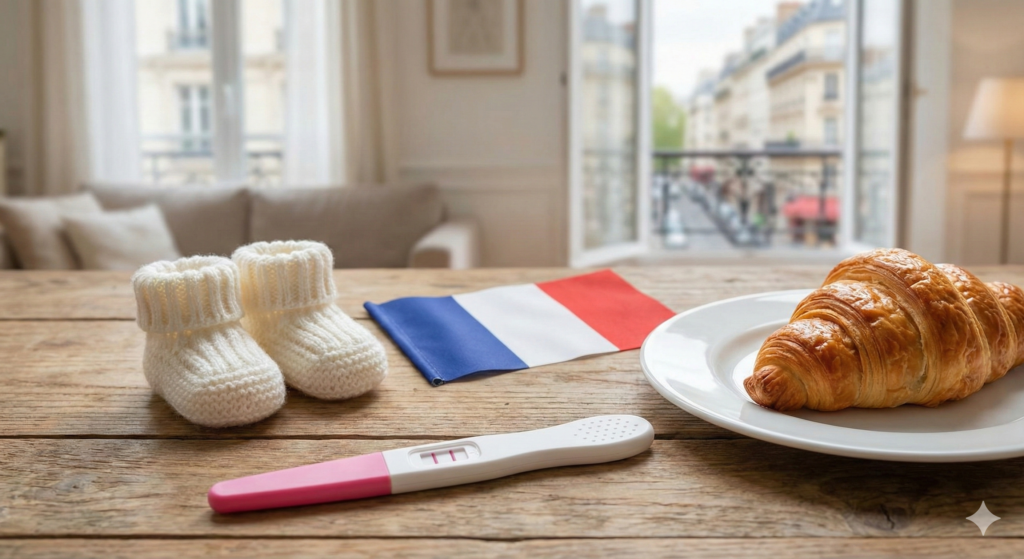
(Note: Before reading this, definitely read my ‘France Health System Guide‘ and ‘CAF & Family Benefits‘ blogs.)
📑 Table of Contents
- 1️⃣ Getting Started: What should be the first step?
- 2️⃣ Medical Tests: Clinic vs Lab
- 3️⃣ The Right Doctor and Ultrasound (Private vs Public)
- 4️⃣ 3-Month Deadline: Most important paperwork
- 5️⃣ Hospital for Delivery (Bed Booking)
- 6️⃣ Financial Support: 100% Coverage
- 7️⃣ Delivery Day: My Real Experience
- 8️⃣ After Birth: Bonding and Hospital Stay
- 9️⃣ Baby’s Registration (CPAM & CAF)
- 🔟 📜 Birth Certificate and Legal Process
- ❓ FAQ: Hospital Life and Facilities
- 💡 Pro-Tips (To save you from future stress)
- 💛 Conclusion (Final Thoughts)
1️⃣ Getting Started: What should be the first step?
As soon as your home test comes positive, understand one thing: nothing happens in France without an appointment.
The rule in France is: first, meet your GP (General Practitioner). Your GP will write you a prescription for the official blood and urine tests.
My experience (With a Temporary Number):
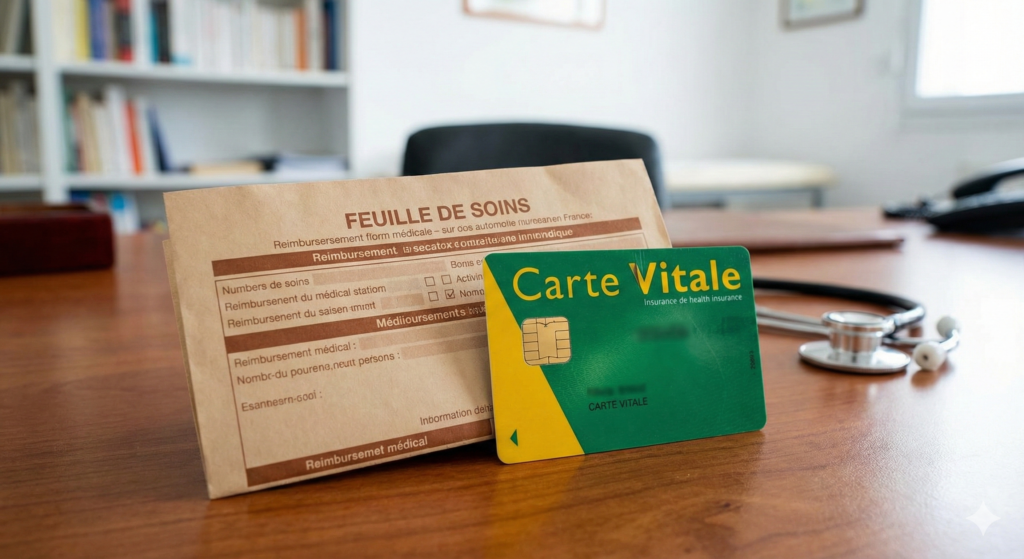
At that time, my Carte Vitale hadn’t arrived, and I only had a Temporary Social Security Number.
- The fear: Will I get treated?
- The reality: Yes, absolutely. I directly booked an appointment with a gynecologist. I paid the fees out of my own pocket first, and later sent the ‘Feuille de Soins’ (brown paper) I got from the doctor to my CPAM office (via Post or Drop-box) and got my money reimbursed. The system never denies you treatment.
2️⃣ Medical Tests: Clinic vs Lab
The system is a bit different in France:
- Doctors only give a prescription.
- You have to go to a Laboratoire (pathology lab) near your house.
- Most tests are done empty stomach in the morning.
- Reports come via email and directly reach the doctor’s system, too.
3️⃣ The Right Doctor and Ultrasound (The truth about Private vs Public)
I had chosen an English-speaking Sector 2 (Private) doctor for myself.
- The perk of going private: My doctor had an ultrasound machine right in her cabin. So, along with the monthly check-up, she would show me the baby (they call it a Quick Peek). This was very reassuring.
- The reality of public hospitals: If you go to a govt hospital or a midwife, they don’t have machines in their cabins. You have to take separate appointments at a radiology center for the 3 big official ultrasounds (T1, T2, T3).
4️⃣ 📝 3-Month Deadline: Most important paperwork
Never miss this one deadline in France:
👉 Declaration within the first 14 weeks of pregnancy (almost 3 months).
The doctor gives you the “Premier examen médical prénatal” form. You have to send this to both CPAM (for health) and CAF (for finances). If you can get it declared online (through the doctor), that’s the best way.
5️⃣ 🏥 Hospital for Delivery (Bed Booking)
- Public Hospital: Your bed gets booked as soon as you register here.
- Private Clinic (My case): Clinics only do check-ups. For delivery, I had to personally go to the hospital of my choice and fill out the ‘Inscription Maternité’ (bed booking) form.
💡 Expert Tip: Hospitals get full very fast in Paris or big cities. Register as soon as your pregnancy is confirmed.
6️⃣ Financial Support: 100% Coverage
- Mutuelle (Private Insurance): My delivery was in a private hospital, where the doctor’s fee was higher than the govt rate. This extra expense was covered by my Mutuelle. I started taking benefits from the exact day my Mutuelle got activated.
- 6th Month Magic: From the first day of your 6th month of pregnancy till 12 days after delivery, your entire medical expenses are covered 100% by Social Security.
- CAF Bonus: In the 7th month, you get a ‘birth grant’ from CAF (the condition is that your income must be within their limits).
7️⃣ 🍼 Delivery Day: My Real Experience
In my case, the labour pain started around 2 AM in the night.
We decided that we would go to the hospital, taking the tram and walking a bit in the morning, just to get some steps in and keep the delivery smooth. (We reached the hospital at 6 AM).
⚠️ Caution: Walking there was my own personal decision since the hospital was nearby and I was feeling okay. Please go to the hospital according to your own condition and doctor’s advice.

🩺 Epidural (Pain Relief)
Upon reaching the hospital, the doctor asked: “Would you like to take an epidural?”
I said ‘Yes’. Bearing pain isn’t considered any sort of ‘bravery’ in France. If you want a pain-free delivery, it’s your choice, and it is completely safe.
⏰ Normal Delivery
Around 1 PM in the afternoon, I had a normal delivery in a very peaceful environment.
8️⃣ 🤱 After Birth: Bonding and Hospital Stay
Right after birth, the baby was placed on my chest for 1 hour of skin-to-skin contact. In France, the mother-baby bonding is given even more importance than medical tests.
🏨 Hospital Stay:
We got a private room, and an extra bed was also provided for my husband.
- Fact Check: The cost of the private room and the husband’s stay is often covered by your Mutuelle, not Social Security. Make sure to ask this during check-in.
- I came back home with the baby on the 4th day.
9️⃣ ✅ Baby’s Registration (CPAM & CAF)
After the hospital and Mairie work, come home and do these two things online:
- CPAM: Log in to your Ameli account, go to the “Declaring the birth of a newborn” section, and add the baby.
(Note: The baby gets their own Social Security number at the age of 16; until then, they stay on the parents’ cards) - CAF: Declare the birth on your CAF account too, so your PAJE (Monthly allowance) and other benefits start coming in.
🔟 📜 Birth Certificate and Legal Process (Most important part)
The real running around starts after getting discharged from the hospital. People often make mistakes here, so it is super important to keep these 4 things in mind:
1. The hospital does not automatically make the Birth Certificate
The hospital only gives you a medical paper called “Certificat d’accouchement”.
- The real task: The parents (usually the father) have to personally go to the Mairie (Town Hall) of the hospital’s area to do the birth declaration (Déclaration de naissance).
- Important Documents: When going to the Mairie, you need to carry 1. The hospital certificate (Certificat d’accouchement), 2. Parents’ passports / Residence permit (Titre de séjour), and 3. Marriage certificate (or Livret de famille). (Note: You don’t need to take the baby along for the declaration.)

2. The strict 5-Day deadline for Birth Declaration
You only have exactly 5 calendar days to declare the birth.
- This includes weekends and public holidays.
- ⚠️ Warning: If the 5 days pass, it can become a huge headache. Then the declaration will only happen through the court, which can take months.
3. Finalizing the baby’s First Name at the hospital itself is a must
Yes, this is very important.
- When you get admitted, the hospital staff asks for the name right then.
- The birth certificate is made at the Mairie with that exact name.
- Advice: Keep the name finalized before delivery. Changing the name later in France is a very long and difficult process.
4. The truth about Birth Certificate Translation
People often think that they need to get the translation done within 5 days, too, but this is a myth.
- The 5-day deadline is only for the declaration at the Mairie.
- When do you need the translation? When you have to apply for the child’s passport, OCI, or visa at the Indian Embassy. You don’t need translations for internal French stuff (CAF/CPAM).
❓ General FAQ: Hospital Life and Facilities
Q1: Will I get vegetarian food at the hospital?
👉 Answer: Yes, but there is a big catch.
- Fact: In France, “Vegetarian” is often just understood as “No Red Meat”, and you might get served fish (this happened to me).
- Tip: Clearly state at the time of admission: “Sans viande et sans poisson” (No meat and no fish). Packing some snacks from home is the safest bet.
Q2: Can my husband stay over at the hospital at night?
👉 Answer: If you’ve booked a private room, the hospital provides an extra bed and food for your husband (this is chargeable). Getting permission for this in a shared room is very difficult.
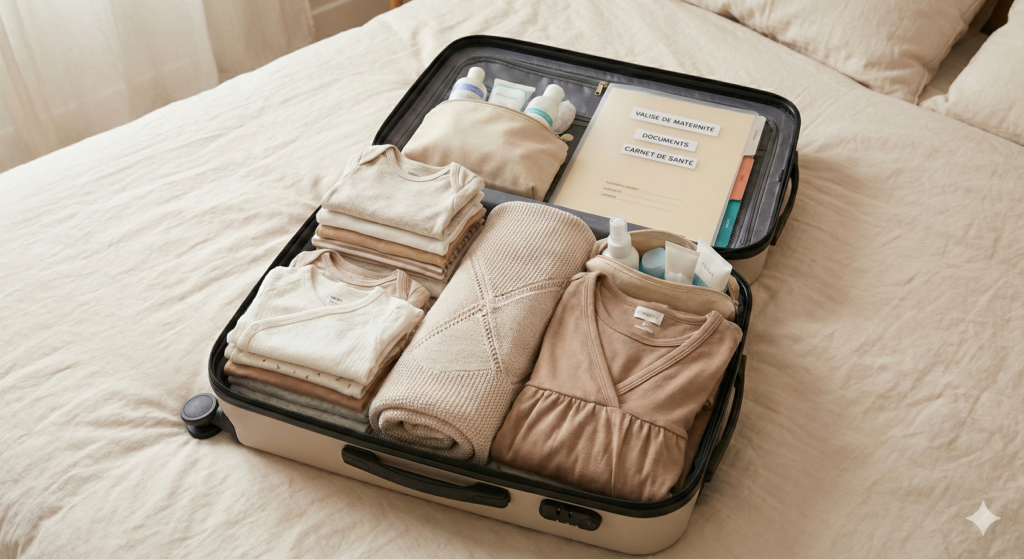
Q3: What’s essential to pack in the “Valise de Maternité” (Hospital Bag)?
👉 Answer: Baby clothes (Bodysuits, Pajamas), comfortable gowns for yourself, toiletries, and original documents. The hospital hands you a checklist around your 7th month.
Q4: What if I don’t understand French during labor pain?
👉 Answer: Don’t panic. The labor room staff is trained for these situations. Most doctors understand basic English. I also used “Google Translate” and hand gestures, and it was totally manageable.
💡 Pro-Tips (To save you from future stress)
- Book appointments in advance – Nothing happens at the last minute in France.
- Vaccine card – Definitely keep your and your partner’s original vaccination cards handy (with an English explanation). This is extremely useful during pregnancy and later for the child’s crèche (daycare).
💛 Conclusion (Final Thoughts)
Pregnancy and delivery in France:
- Is medically safe.
- Is heavily system-driven.
- Is deeply respectful towards both the mother and the baby.
If you do your paperwork on time and don’t miss appointments, the French system stands by you like a strong shield.
This guide isn’t just theory — it’s the exact path I’ve walked myself.
All the best! (Bon Courage!) 💛




No comments yet. Be the first to share your thoughts!