

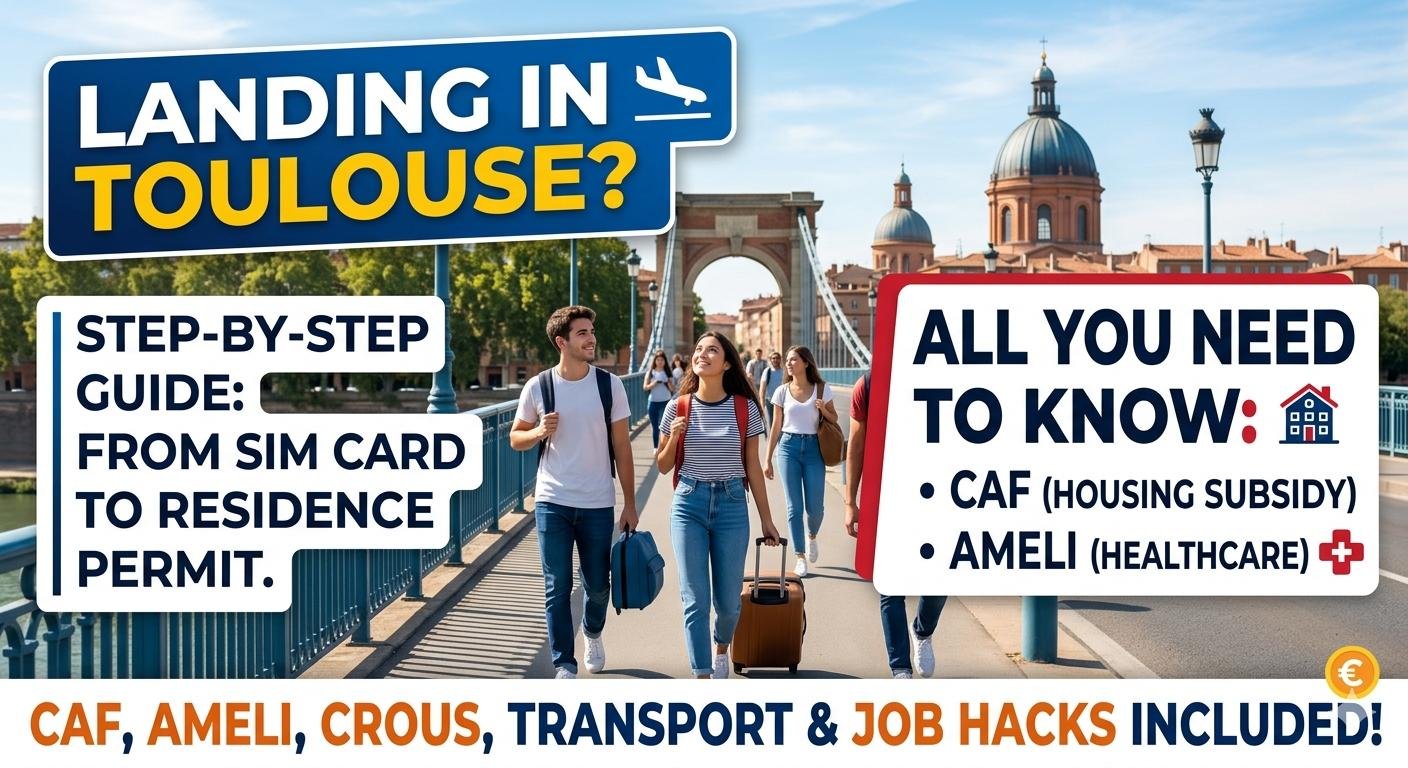
Taking flight to the city of your dreams is just the beginning; the real adventure starts the moment you step onto French soil. Don’t panic—I’ll hold your hand and guide you through this labyrinth of paperwork straight to your destination. The pink walls of Toulouse and its beautiful evenings are waiting for you!
📑 Table of Contents
- Pre-Departure Preparations from India
- After Arriving in Toulouse – Step-by-Step Process
- Step 0: CVEC (Your First & Most Crucial Task)
- Step 0.1: Final University Enrollment (Mandatory)
- Step 1: Phone SIM & Internet
- Step 2: Opening a Bank Account
- Step 3: Visa Validation / OFII
- Step 4: Accommodation & Guarantor (Visale System)
- Step 5: CROUS Process (Affordable Housing & Food)
- Step 6: Applying for CAF (Housing Allowance)
- Step 7: Social Security + Carte Vitale (Ameli)
- Step 8: Mutuelle – The Complete Guide for Students
- Step 9: Transport & Student Card Benefits
- Useful Apps & Address Sync (Modern Student Hacks)
- Part-Time Jobs, Taxes, and Renewal (Long-Term Rules)
- Where to Get Help? (Support & Community)
The dream of studying in France is beautiful, but without the right preparation, even the smallest things can become major headaches. Navigating administration and paperwork in a new country is never easy.
In this post, you’ll find all the practical, on-the-ground information you need to avoid common pitfalls and take full advantage of every benefit you’re entitled to as a student.
✈️ Part 1: Pre-Departure Preparation (From India to France)
“Half the battle is won right at the packing table with the right paperwork.”
Building a strong foundation is your first task. If you make a mistake here, your administrative work in France will come to a halt:
📄 1. Documents (The Absolute Essentials)
Keep these documents perfectly organized before you leave India:
- Mandatory: Passport, Visa (VLS-TS), University Admission Letter, and Proof of Accommodation (at least for your first few days).
- Extra but Crucial: Birth Certificate and Marriage Certificate (if applicable).
✅ Pro Tip (2026 Birth Certificate Update): In France, authorities like CAF and Ameli no longer accept Birth Certificates older than 6 months. Right before leaving India, get a fresh certificate from your Municipal Corporation (Nagar Nigam) and ensure it has an Apostille stamp. Once in France, get it translated into French only by a Certified Sworn Translator (Traducteur Assermenté). This is the safest and most recommended route.
💡 Extra Tip: Make 4–5 physical photocopies of all your documents and keep a master folder of soft copies (PDFs) saved securely on your Google Drive.
💰 2. Financial Readiness
- The Minimum Limit: According to visa rules, you must show proof of at least €615 per month.
- Practical Advice: Honestly, €700–€800/month is considered the safe zone (for both visa approval and actual survival).
⚠️ Urgent Alert: This minimum required amount is subject to change based on new embassy regulations. Always verify the exact, latest figure via official French Embassy notifications before preparing your bank statements.
Cash & Cards: Carry roughly €300–€500 in hard cash and a reliable international forex card (like Niyo Global or Wise). This ensures you aren’t stranded without funds while waiting for your French bank account to open.
🇫🇷 Part 2: Welcome to Toulouse – Your Step-by-Step Action Plan
The moment you arrive, tackle these tasks in this exact sequence:
🎓 Step 0: CVEC (Your Very First Mission)
This is ground zero. Before you can finalize your registration at any French university, you absolutely must pay the CVEC (Contribution Vie Étudiante et de Campus). Without it, the university won’t generate your roll number or student card.
- Fee: Around €107-€110/year (Updated 2026 rate).
- How to do it: Head over to the official CVEC portal, create an account, and pay online. You’ll receive an ‘Attestation’ (certificate) which you must submit to your university.
🎓 Step 0.1: Final University Enrollment (Critical)
Once CVEC is sorted, your next hurdle is your Final Enrollment (Inscription Administrative).
- Log in to your university portal and upload all requested documents.
- Pay your tuition fees (if applicable).
- Following this, you’ll be issued your Student ID Card and login credentials.
Note: Even if you paid your CVEC, skipping this step means you are not officially considered a student.
📱 Step 1: Getting Connected (SIM & Internet)
Grab a local SIM card immediately upon arrival (Free, Orange, SFR, etc.). You need a French phone number to open a bank account, apply for housing allowance (CAF), and receive OTPs.
✅ Pro Tip: Walk into any local mobile network store, flash your University Letter, and ask about “Student Plans.” You can often snag a much cheaper and better deal just by proving you’re a student.
Budget Option: You can also pick up a Lebara or Lyca SIM from any Tobacco Shop (Tabac) or supermarket. Their prepaid plans are incredibly budget-friendly for your first few weeks.
🏦 Step 2: Opening Your Bank Account
“In France, your RIB (bank account details) is the key to your identity. Without it, no government refunds will ever reach you.”
You have two paths here:
- The Fast Track (Online Banks): Neobanks like Revolut or Nickel are lifesavers. Download the app, scan your passport and visa, snap a selfie, and boom—your account and RIB are ready in 10 minutes. Perfect if you need an account number immediately.
- The Traditional Route (Physical Banks): If you prefer big names like BNP Paribas or LCL, you’ll need to physically visit the branch and book an ‘Appointment’. Be prepared to wait 1-2 weeks.
Reality Check: In 2026, online banks like Revolut and Nickel successfully provide a French IBAN (starting with FR). A French IBAN makes dealing with government services (like CAF) significantly smoother, though opening a traditional account later on is still good practice.
💡 Recommendation – Parrainage (Referral Codes): The ‘Referral’ culture is huge in France, especially for mobile networks and banks. New students can easily pocket a €10-€50 bonus by using a friend’s referral code. To support this blog, feel free to use my Revolut code anandp29z to claim your sign-up bonus. Join Revolut using my referral link!
🧾 Step 3: Visa Validation / OFII
Validating your visa online within 3 months of arriving is a strict legal requirement.
- Advice: Since administrative portals can be slow, knock this out as soon as you settle in.
- How to do it: Visit the ANEF Foreigners in France Portal.
- Fee: You will need to purchase a digital tax stamp (Timbre Fiscal) online for approximately €50.
- Update: The process is entirely digital now. The old offline medical checkup system by OFII has been scrapped for the vast majority of student cases.
🏠 Step 4: Accommodation & Guarantors (The Visale System) ❗
House hunting in France is notoriously difficult.
- The Guarantor Rule: French landlords will always ask for a Guarantor (someone to back up your rent payments).
- For International Students: Apply for Visale immediately. This is a brilliant, free government service that acts as your guarantor. It’s a game-changer for finding housing.
- Where to look: If you didn’t get a government dorm (CROUS), try searching on Lokaviz, Leboncoin, or Residence Habitat Jeunes.
⚠️ Beware of Scams: Stay hyper-vigilant when house hunting online. Never wire rent or deposit money before doing an in-person visit and having the physical keys in your hand. Housing scams targeting international students are rampant.
⚠️ Mandatory (Assurance Habitation): Home insurance is compulsory by law in France. A landlord will refuse to hand over the keys without it. Grab a cheap, online student policy from Luko or Smerra.
💰 Dépôt de Garantie (Security Deposit): Landlords will ask for 1 to 2 months’ rent upfront as a deposit. To ensure you get this back when you leave, pay extreme attention to the “Etat des Lieux” (the move-in inventory check). Make sure every single scratch, stain, or broken item is officially documented.
🏛️ Step 5: The CROUS Process (Budget Housing & Food)
There is only one master portal for all government student services:
- The Website: Create an account on MesServices Étudiant.
- DSE (Dossier Social Étudiant): Fill out this central form to apply for state-run dorms and scholarships.
- Booking a Dorm: Navigate to ‘Trouver un logement’ and filter for residences in Toulouse.
- Izly Pay: Download this digital wallet app and link it to your student card. You can now eat a full, multi-course meal at the university cafeterias (Resto U) for just €3.30!
💸 Step 6: Applying for CAF (Housing Allowance)
The Benefit: The French government generously subsidizes a portion of your monthly rent. There is no upper age limit to claim this.
How to Apply:
- Go to the CAF website and select the “Logement” (Housing) section.
- If you’re applying for the first time, choose “Vous n’êtes pas allocataire”.
- Home details: Enter your address, move-in date, and rent amount. You’ll need the SIRET number of your CROUS residence or private agency (find this on your lease).
- Income Declaration: Most new students declare “€0”. However, if you had taxable income in India the previous year, you technically need to declare it.
- Bank Details: Add your French bank account (RIB).
- Upload Documents: Passport, Visa (VLS-TS), Lease Agreement, and your Sworn Translated Birth Certificate.
- Wait: Eventually, you’ll receive your unique “Numéro d’allocataire” (beneficiary number).
⚠️ The Reality of CAF Delays: Expecting a 2 to 3-month delay in processing is completely normal. Do not panic. The allowance is calculated from the month *after* you move in, and you will eventually receive the accumulated missed months as a lump sum (Arrears). Keep an eye on your portal—if they request additional documents, provide them immediately.
🏥 Step 7: Social Security & The Carte Vitale (Ameli)
The French healthcare system reimburses roughly 70% of your doctor visit fees and prescription medications. To cover the remaining 30%, you can opt for a “Mutuelle” (private top-up insurance).
🩺 The Doctolib App: Download Doctolib to book medical appointments. Use the search filters to specifically find English-speaking doctors to avoid language barriers.
The Process:
- Phase 1 (Temporary): Register on the Ameli Foreign Student Portal to receive your Temporary Number (Attestation Provisoire). Print this out.
- Phase 2 (Permanent): Once your documents are fully verified, you’ll receive your permanent Social Security Number (Numéro Définitif) via mail or email.
- Phase 3 (Account Creation): Go to the main Ameli website. Click “Créer mon compte” and set up your login using your new permanent number.
- Phase 4 (Ordering the Card): Log in, navigate to “Commander ma Carte Vitale”, upload your photo and ID, and the physical green card will be mailed to your address.
- Phase 5 (Activation): Once the card arrives, take it to any local pharmacy, insert it into the green machine (Borne), and update it.
💡 Crucial Health System Hack: If you do not officially declare a “Médecin Traitant” (Primary Care Physician), your reimbursement rates will drop significantly. During your very first doctor’s visit, explicitly ask the doctor to declare themselves as your primary physician in the system.
🛡️ Step 8: Getting a Mutuelle (Top-up Health Insurance)
“Should students really pay for a Mutuelle? Yes, absolutely! Ameli only covers 70%, and an unexpected hospital visit for the remaining 30% can burn a hole in your pocket.”
- Eligibility: You need your Social Security Number, Student Certificate, and a French RIB.
- Best Options: Look into student-focused providers like Heyme (~€10-€15/month), Smerra, or LMDE.
- Télétransmission (The Magic Word): Ensure your Ameli account and Mutuelle are linked via ‘Télétransmission’. This means both the 70% and 30% refunds will be automatically routed to your bank account without you lifting a finger.
🚌 Step 9: Transportation & Student Card Perks 🎓
Public transport in Toulouse (Tisséo) is exceptionally student-friendly and affordable.
- Tisséo Pastel Card: Just having the transport app isn’t enough; you must order a physical physical “Pastel Card” (costs around €8-€10). Your monthly unlimited pass is loaded onto this card.
- Under 26 Pricing: A 31-day unlimited bus, tram, and metro pass costs a mere ~€15–€20.
- Pro Tip: Visit the main Tisséo agency at the Jean Jaurès station to get your card printed on the spot.
🎓 Flash Your Student Card For: Massive discounts (or completely free entry) at national museums, heavily discounted cinema tickets, and reduced fares on SNCF regional and national trains.
🎁 Part 3: Essential Apps & Address Syncing (Modern Student Hacks)
Turn your smartphone into a survival tool with these must-have apps:
- Too Good To Go: Rescue unsold, perfectly good restaurant food for a fraction of the price.
- Unidays & StudentBeans: Access aggressive student discounts on global brands like Apple and Nike.
- Lydia / Paylib: The French equivalent of Venmo/UPI for splitting bills with friends.
- SNCF Connect: Buy the ‘Carte Avantage Jeune’ discount card for cheap intercity train travel.
- Leboncoin: The absolute best marketplace for buying second-hand furniture and electronics.
⚠️ Leboncoin Scammer Warning: The platform is great, but scammers exist. Always meet the seller in person in a public place, inspect the item, and *then* hand over the cash. Never do advance digital transfers.
⚠️ The Address Syncing Trap: Countless students face frozen bank accounts or suspended CAF payments because of address mismatches. Make it a religious habit: whenever you move, update your exact new address across CAF, Ameli, OFII, and your bank simultaneously.
💼 Part 4: Part-Time Jobs, Taxes, and Visa Renewal (Long-Term Rules)
- Work Rights & Wages: As an international student, you are legally allowed to work a maximum of 964 hours per year. The minimum wage (SMIC) sits at roughly ~€12.00–€12.50+ gross/hour (Updated for 2026).
- Job Hunting Without French: Look into English-speaking babysitting agencies (Mômji) or food delivery (UberEats). University libraries and administrative desks also occasionally hire students.
- Impôts (Filing Taxes): You are legally required to declare your taxes on impots.gouv.fr. Even if you earned absolute zero, file a zero-income return. The resulting tax certificate (Avis d’impôt) is highly requested during visa renewals.
🪪 4. Titre de Séjour (The Residence Permit Process)
“Your first-year visa is just an entry ticket. Converting it into a plastic residence card and renewing it is the real test of staying in France.”
- VLS-TS Validation (Year 1): Validate online within 3 months. This acts as your legal residence permit for the first year.
- Renewal (Year 2 Onwards): Apply for a renewal (‘Renouveler mon titre de séjour’) on the ANEF Portal about 2-3 months *before* your current visa expires.
- Required Docs: Passport, old visa, university enrollment for the next year, proof of attendance (Assiduité), transcripts, and fresh bank statements proving you still have €615/month.
⚠️ Renewal Risk Factors (Tread Carefully):
- Low Attendance: The Prefecture scrutinizes your class attendance. Excessive unexcused absences can lead straight to a renewal rejection.
- Fake Enrollment: Enrolling in a “ghost” school just to maintain student status is heavily penalized and can lead to immediate deportation.
🤝 Part 5: Where to Find Help? (Indian Community Toulouse – ICT)
Your greatest support system in the city is the “Indian Community Toulouse (ICT)”. This highly active network helps newcomers navigate the initial culture shock.
- Welcomedesk (Toulouse): The University of Toulouse runs a dedicated support center offering free, in-person help with CAF and Prefecture paperwork.
- ESN (Erasmus Student Network): Join this massive student club to travel locally and make friends from all over the world.
🚨 Emergency Contacts: 15 → Medical (SAMU) | 17 → Police | 18 → Fire Brigade | 112 → Universal European Emergency
✨ Final Thoughts
During your first few months, French administration will feel overwhelmingly slow. Take a deep breath. The system is heavily regulated to protect your rights. Practice patience, follow this guide step-by-step, and you will be perfectly fine.
“My goal is to make your journey as smooth as possible. If you feel any crucial information is missing or if you have a recent 2026 update to share, please drop your valuable insights in the comments. Your small tip might solve a massive problem for the next student arriving.”
Special Thanks: “A heartfelt thank you to Harshit Bhatia, whose personal experiences and valuable suggestions profoundly enriched this guide. Your inputs will undoubtedly serve as a lifeline for incoming readers.”
🔑 Key Takeaways
- Always carry an Apostilled Birth Certificate (issued within the last 6 months) and sufficient financial proof from India.
- Pay your CVEC tax immediately upon arrival, and prioritize opening a French Bank Account to get your RIB.
- Patience is key: CAF and Ameli procedures frequently take 2 to 3 months to finalize. Ensure your uploaded documents are flawless to avoid resets.
- Protect yourself against housing and marketplace scams—never transfer money in advance without an in-person viewing and contract signing.
- Treat your visa renewal seriously by maintaining high academic attendance and syncing your physical address across all government portals.
❓ Frequently Asked Questions (FAQs)
How long does it take to receive the CAF housing allowance in France?
The standard processing time for CAF is usually 2 to 3 months. Don’t worry about the delay—the allowance calculation begins the month after your move-in date, and the accumulated funds will be deposited into your account as a lump sum (arrears) once approved.
Do international students need a guarantor to rent an apartment in France?
Yes, securing a guarantor is practically mandatory to rent private housing in France. However, international students can utilize ‘Visale’, a completely free government-backed guarantor service accepted by most student residences and private landlords.
What is the CVEC fee, and when should I pay it?
The CVEC (Contribution Vie Étudiante et de Campus) is a mandatory student campus life tax. You must pay this fee online before you can finalize your administrative enrollment at any French higher education institution. Without it, you cannot receive your student card.

No comments yet. Be the first to share your thoughts!