

🇫🇷 CAF Registration in France: A Complete Practical Guide for Expat Families
After arriving in France, the most confusing part of paperwork isn’t just the health system — the family benefits system is equally critical. This guide is based on real experiences, so you don’t repeat the same mistakes that most new expat families unknowingly make.
After moving to France, I thought Social Security would be the toughest part. But the real confusion started with CAF.
In France, the systems are clearly divided:
- For health coverage: Caisse Primaire d’Assurance Maladie (CPAM)
- For family and housing benefits: Caisse d’Allocations Familiales (CAF)
👉 Important Reality: If you have kids and you are ignoring CAF, you might be missing out on legally available benefits.
Table of Contents
1. What does CAF offer and how does it work?
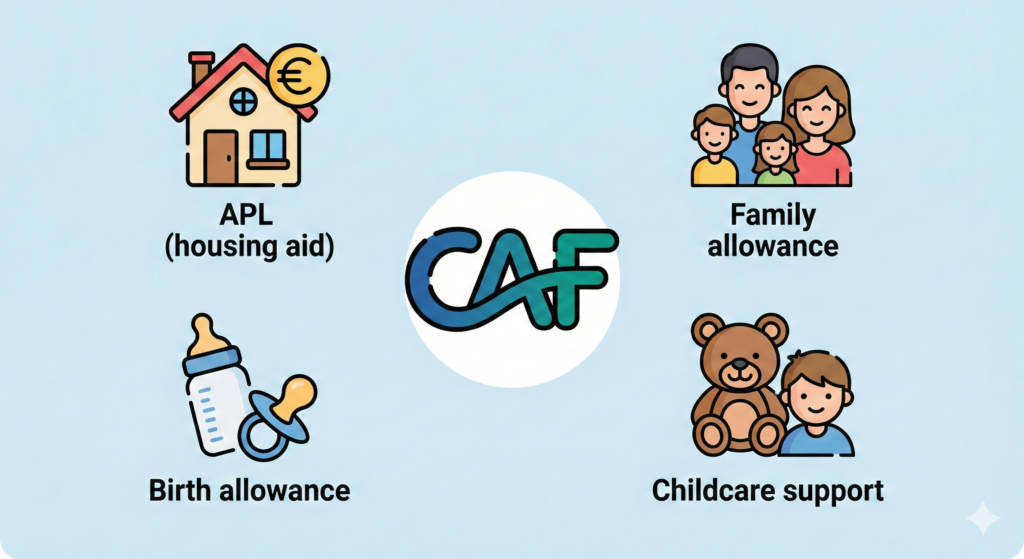
Not everyone gets the same amount in CAF. The benefit amount depends on: household income, Visa status, family size, rent/housing situation, and tax declaration.
Possible Benefits:
- Family Allowance
- APL (Housing Aid)
- Birth Allowance
- Childcare Support
⚠️ Very Important: CAF benefits are not automatic. Applying is mandatory.
2. Preparation – Ensure this before applying for CAF
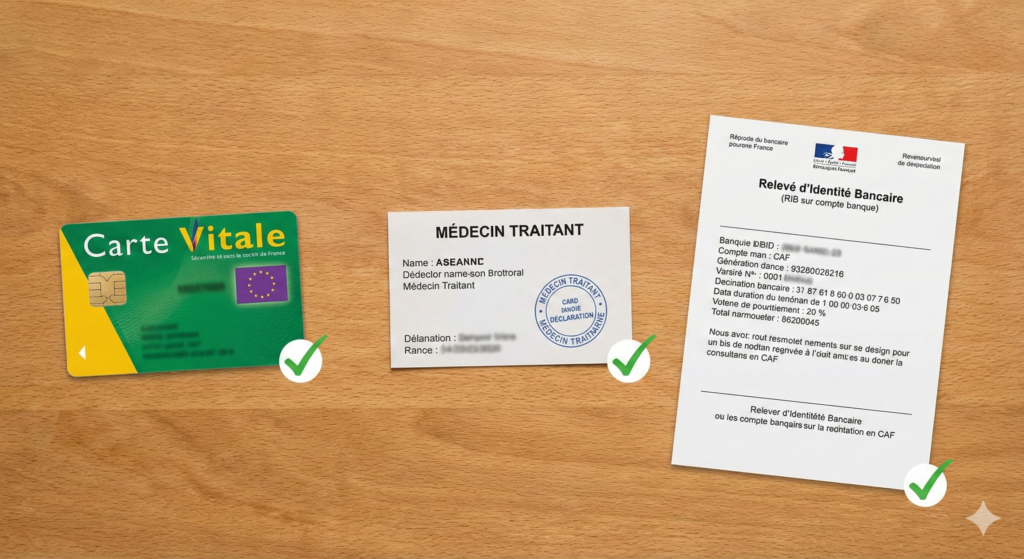
Before CAF registration, completing this basic setup is very important:
- ✔ Must have applied for Social Security (temporary number also works)
(If you haven’t applied for CPAM yet or want to understand the process, you can read my detailed guide here: The Complete Guide to CPAM & Carte Vitale) - ✔ Declared a GP (Médecin Traitant)
- ✔ The health system is properly active
CAF and the health system are not directly, but indirectly linked — especially in pregnancy and family benefits cases. If the health setup is clear, the CAF process becomes quite smooth.
When to register for CAF?
Best time to apply:
- Already received the Social Security number
- French Bank Account (RIB) is ready
- Have a stable address
👉 Golden Rule: The sooner you apply, the better.
3. The Application Process – How to apply for CAF?
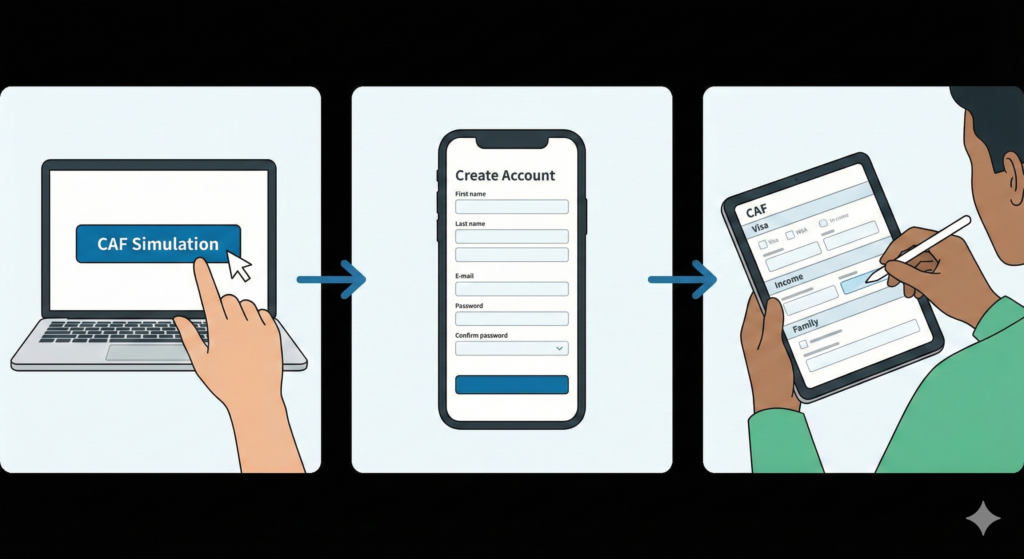
Step 1: Simulation Check (Must do first)
Use the simulation tool on the CAF website. In 5 minutes, you get to know whether you are eligible or not and approximately how much you can get.
Step 2: Create a CAF Account
Required Documents:
- Social Security Number
- Address and Email
- Birth Certificate (for children’s details)
- RIB (French bank details)
⚠️ RIB Name Match Rule (Very Important): The name on the RIB must be the exact same as the CAF account holder (or it should be a joint account). Name mismatch → Payment can get rejected.
🛑 Temporary Social Security Number Case: If you don’t have a permanent Social Security number, the online account might get blocked, and you might have to apply via a paper form. Once you get the permanent number, the process becomes quite easy. After the account is created, you will get: 👉 Numéro allocataire (CAF ID).
Step 3: Fill the CAF form carefully
The CAF form asks for Visa type, residence permit validity, France entry date, work status, and income details.
⚠️ Don’t fill in Visa and income details casually — eligibility heavily depends on these two.
4. The Complexities – Rules you MUST know
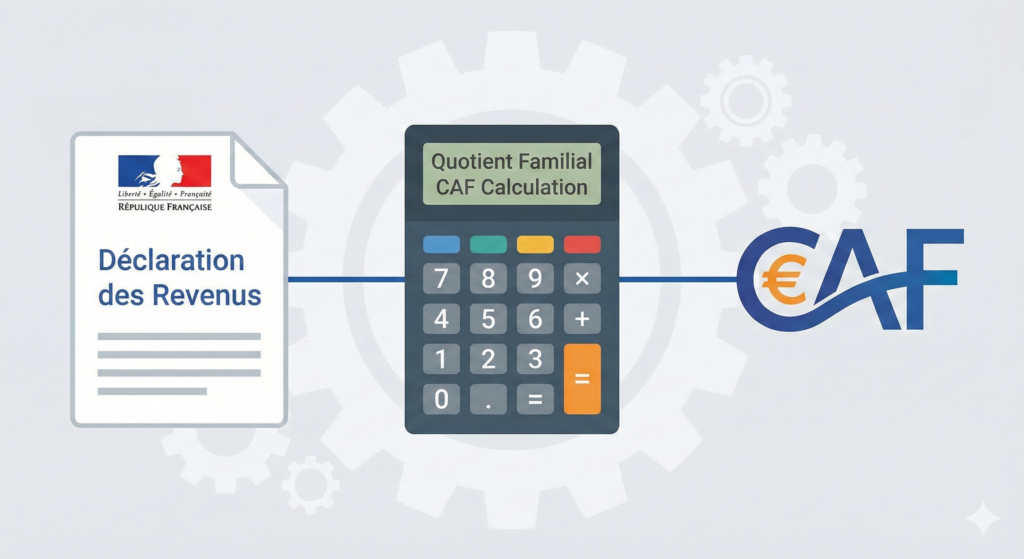
The Role of Tax (Super Important)
CAF is entirely an income-based system. CAF income data is linked to the tax system. If you haven’t declared taxes, salary slips might be requested, and processing can get delayed.
First Tax Year Confusion: For new arrivals, the first year RFR is not available, so CAF might ask for current income proof or estimated income.
Are Passport Talent holders eligible?
Yes. CAF doesn’t look at Visa prestige — it looks at household income. If your income is within the threshold, you can get the benefit.
Dependents and CAF Calculation
The French tax system runs on ‘parts’ (shares) (like husband = 1, wife = 1, first child = 0.5, etc.). But CAF’s calculation is a bit different from this.
CAF doesn’t just look at your yearly income (RFR), but calculates a ‘Quotient Familial’. It combines your monthly income, the CAF benefits you receive, and the number of family members to do a calculation using a different formula. So, don’t get confused by considering the tax office’s calculation directly as CAF’s final amount.
Legal Status of Children (For Expat / Non-EU Families)
In France, CAF benefits for children are only given when they have arrived in France under a proper legal process, like through OFII (Regroupement Familial) or on a proper dependent Visa.
If kids are on a tourist Visa or without proper legal entry proof, CAF benefits are not provided for them. This rule strictly applies to non-EU families.
Pregnancy Case (Brief Intro)
During pregnancy, CAF and CPAM are linked to each other. If you meet the income threshold, you get a ‘Birth Allowance’ (Prime à la naissance) from CAF. For this, it is mandatory to declare to CPAM and CAF within the first 14 weeks.
(Note: The entire process of pregnancy declaration and its related benefits is quite detailed, so I will bring a completely separate detailed blog post on this very soon!)
APL Reality (Housing Aid)
If you live on rent, you must have a valid rental contract. ⚠️ If your income is high, APL can even be zero — this is normal.
5. Pitfalls and Warnings – Don’t make these mistakes
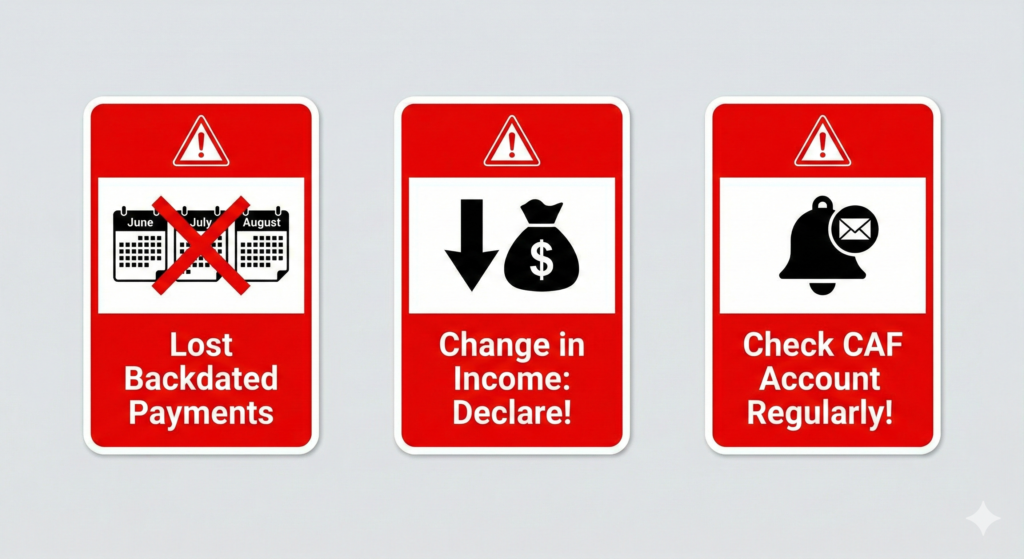
🔎 Backdated Payments – Critical Add-on Point
Many people don’t know this: CAF benefits are counted from the application month, not the arrival date.
- Example: Were eligible in June, applied in September.
- 👉 Result: June–August money is usually lost.
Don’t delay. Late apply = lost months.
Change in Income Rule and Overpayments
If you lose your job or maternity leave starts, doing a Déclaration de changement de situation is mandatory. If CAF declares an overpayment (meaning you received extra money), you can request installments (a payment plan). Heavy deductions don’t happen all at once.
Separation / Spouse Abroad Case
If the spouse is in your home country or temporarily abroad, The CAF calculation structure can change. This is a very common scenario in expat families — don’t ignore it.
CAF Account Communication Habit
CAF mostly doesn’t send postal letters. Communication mainly happens through online account messages.
⚠️ If you don’t reply within 30 days → the file might get closed. 👉 Checking the account regularly is realistic and necessary.
Final Advice
The benefits system in France is structured and supportive. Yes, it feels a bit technical — but it empowers you in the long term.
If you are newly arrived from your home country, a dependent spouse, a young family, or fall into the low/moderate income category 👉 Don’t delay CAF.
The system runs on numbers — but behind those numbers are real families 💛
📌 FAQs and Official References
1: Are CAF and CPAM the same system?
No. The systems are separate in France:
- Health Insurance → Caisse Primaire d’Assurance Maladie (CPAM)
- Family and Housing Benefits → Caisse d’Allocations Familiales (CAF)
👉 But in cases of pregnancy, birth allowance, and family benefits, the data can be indirectly linked. That’s why having the health system properly set up makes the CAF process smooth — but CAF doesn’t control healthcare.
2: Do you get CAF benefits automatically?
❌ No. CAF benefits are never automatic.
- ✔ An application is required for every benefit
- ✔ CAF checks the eligibility
- ✔ Approval comes after documents are verified
👉 Didn’t apply = won’t get the benefit (even if you are eligible).
3: Why is there confusion regarding backdated payments?
Reality check: CAF benefits are counted from the 👉 application month, not the arrival date.
- ✔ If you were eligible in June
- ✔ But applied in September
- ➡ Payment for June–August is generally lost
⚠️ Exceptions happen in rare cases (administrative error), not in normal cases. Therefore, early application is very important.
4: How reliable is the CAF simulation tool?
The simulation tool on the CAF website gives an idea of eligibility and estimates an approx amount. ⚠️ It doesn’t give a guarantee.
The final amount depends on: Tax data (RFR), family situation, and latest income updates. 👉 So consider the simulation as guidance, not the final decision.
5: Are Passport Talent holders eligible or not?
✔ Yes, they can be. CAF doesn’t look at Visa prestige; CAF looks at: household income, legal residence (séjour régulier), and family composition.
❌ “High Visa = No benefits” — this is a myth.
❌ “Foreigners don’t get CAF” — this is also wrong.
👉 Fall within the income threshold → benefit is possible.
6: Are there extra conditions for non-EU (International) families?
✔ Yes, there are some administrative conditions:
- Valid long-stay Visa/residence permit
- Regular residence in France
- Legal entry proof for children (if non-EU)
⚠️ CAF doesn’t discriminate based on nationality, but legal stay proof is mandatory.
7: How does pregnancy declaration work for CAF?
Pregnancy:
- ✔ Early declaration to CPAM is mandatory (for health coverage)
- ✔ Have to declare pregnancy/birth to CAF (for benefits)
Birth Allowance: Meeting the income threshold is necessary. Late declaration → delay or rejection possible. 👉 CAF doesn’t control the medical part of pregnancy, but CAF handles birth-related benefits.
8: Didn’t declare first-year tax — will CAF reject it?
❌ Doesn’t reject directly, but:
- ✔ CAF might ask for current income proof
- ✔ Salary slips/employer certificate might be required
- ✔ Processing can get slow
👉 RFR is not available in the first tax year — CAF is prepared for this situation.
9: What does CAF overpayment mean?
CAF overpayment means: According to CAF, you received an extra amount.
- ✔ You can request installments (payment plan)
- ✔ A heavy deduction all at once is rare
- ✔ Communication happens through the account
👉 Don’t ignore it — a timely reply brings a solution.
10: Spouse is in the home country or temporarily abroad — does it make an impact?
✔ Yes, it makes an impact. CAF looks at the household: who is residing in France and the legal status of the dependents.
This is a very common scenario in expat families, so declaring the details accurately is important.




[…] Before reading this, definitely read my ‘France Health System Guide‘ and ‘CAF & Family Benefits‘ […]